

MIU Spotlight at University of Iowa College of Public Health explores whole-person health and integrative prevention
As chronic diseases continue to drive health care costs and reduce quality of life across the United States, Maharishi International University and the University of Iowa are exploring how prevention science, integrative medicine, and public health can work together to improve community health.
Researchers have identified many effective ways to prevent chronic disease. The challenge now is translating that knowledge into practical, scalable approaches that help people make healthier choices in everyday life.
That challenge was the focus of a recent invited Spotlight Session at the University of Iowa College of Public Health, where MIU’s Dr. Robert Schneider presented “Integrative Prevention and Public Health: A Practice-Based Collaboration Model.”
The invitation followed an earlier MIU visit by leaders from the University of Iowa College of Public Health and Carver College of Medicine, making the Spotlight Session part of a growing exchange between the two institutions.
The presentation highlighted areas of shared interest between MIU’s work in Consciousness-BasedSM and integrative health and the University of Iowa’s strengths in public health research, education, implementation, and community engagement. Leaders from both institutions discussed opportunities for student projects, faculty collaboration, community health initiatives, and pilot research studies.
Toward whole-person, integrative care
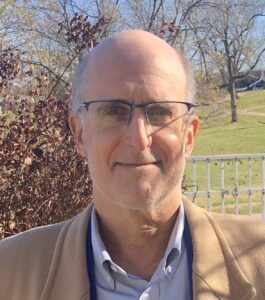
Dr. Schneider, Distinguished Professor of Integrative Medicine and Health and Director of the Institute for Natural Medicine and Prevention, described one of the central challenges in modern prevention: helping proven approaches reach people in practical, consistent, and scalable ways.
“Public health has made tremendous progress in identifying the major drivers of chronic disease,” Schneider said. “The next frontier is implementation — creating practical, accessible systems that help people translate prevention science into healthier daily life. This is where whole-person, integrative care can make an important contribution.”
Drawing on decades of NIH-supported research in cardiovascular prevention, health equity, stress reduction, and lifestyle medicine, Dr. Schneider introduced Total Health Centers, LLC, an Iowa-based model for whole-person prevention that combines modern medicine with evidence-based lifestyle, behavioral, and integrative approaches.
Schneider’s presentation focused on major chronic health challenges, including hypertension, obesity, diabetes, heart disease, mental health conditions, dementia risk, and healthy aging. Its distinguishing feature is a whole-person framework that addresses not only biological risk factors but also behavior, stress, mental well-being, social context, and long-term resilience.
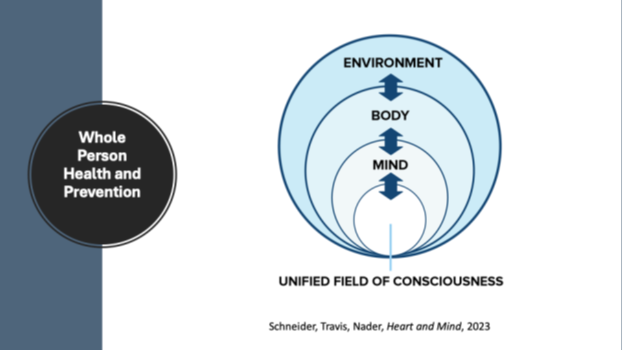
The framework reflects ideas described in a recent Heart and Mind editorial by Schneider, Fred Travis, and MIU President Dr. Tony Nader, which proposed a unified systems medicine perspective linking mind, body, environment, and consciousness in promoting health and resilience.
Peace through health
Schneider argued that prevention can be viewed at the community and societal levels. He discussed the principle of “peace through health,” connecting whole health with individual, community, and societal well-being.
Schneider also discussed research on the Maharishi Effect and the potential role of collective meditation-based practices in reducing social stress and improving community quality of life. The presentation reflected MIU’s long-standing commitment to bringing rigorous science to the study of consciousness, mind-body medicine, Ayurveda, and integrative approaches to health.
Joining prevention science and whole-person health
“Dr. Schneider’s presentation showed how rigorous prevention science and whole-person health can come together in ways that are highly relevant to today’s public health challenges”
— Dr. Robert B. Wallace
“Dr. Schneider’s presentation showed how rigorous prevention science and whole-person health can come together in ways that are highly relevant to today’s public health challenges,” said Dr. Robert Wallace, the co-host for the visit. “It was especially valuable to see how these ideas can be translated into practical models for community benefit.” Wallace is the Irene Ensminger Stecher Emeritus Professor of Epidemiology and Internal Medicine at the University of Iowa.
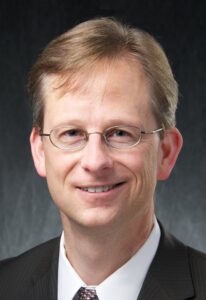
Dr. Mark VanderWeg, Dr. Schneider’s host, emphasized the importance of implementation and community engagement. “A central question in public health is how evidence-based practices can be developed, evaluated, and delivered in partnership with communities,” he said. “Practice-based models that connect prevention research, behavioral interventions, and real-world delivery systems offer important opportunities for student learning, faculty collaboration, and public health impact.” VanderWeg is Professor and Head of the Department of Community and Behavioral Health at the University of Iowa College of Public Health.
The discussion included possible collaboration pathways between MIU, Total Health Centers, and the University of Iowa College of Public Health, including student practica, capstone and thesis projects, community outreach, faculty collaboration, and pilot studies. The session concluded with a discussion of next steps, including the possibility of an exploratory working group to identify shared priorities.
“This kind of exchange is exactly what is needed to move prevention forward,” Schneider said. “MIU brings a long-standing commitment to the scientific study of consciousness, mind-body medicine, and integrative approaches to health. By working with public health partners, we can explore practical ways to bring these approaches into the broader systems of prevention, research, education, and community service.”
For further information:
Robert Schneider, Frederick Travis, and Tony Nader, “Addressing Clinician Burnout: A Unifying Systems Medicine Model with Meditation as a Heart-Mind Intervention,” Heart and Mind 8:1 (2023).
Robert H. Schneider, Michael C. Dillbeck, Gunvant Yeola, and Tony Nader, “Peace Through Health: Traditional Medicine Meditation in the Prevention of Collective Stress, Violence, and War,” Frontiers in Public Health 12 (2024);12:1380626.
Maharishi International University and Consciousness-BasedSM are protected trademarks and are used in the United States under license or with permission.