

New national high blood pressure guidelines recognize Transcendental Meditation
The American Heart Association and American College of Cardiology have just updated their 2025 High Blood Pressure Guideline — and they recognize the Transcendental Meditation (TM) technique as an evidence-based method for lowering blood pressure.
This is the first time any meditation technique has been included in an AHA/ACC hypertension guideline. TM may now be recommended alongside lifestyle changes and medical therapy.
The TM technique is the only meditation procedure cited, with evidence rated moderate to high quality. Other meditation and mindfulness practices were not included due to weaker data.
This AHA/ACC guideline represents the nation’s most authoritative high blood pressure treatment recommendations.
Why this matters:
- Hypertension is one of the world’s leading preventable health problems
- Stress is a major driver — but proven stress-reduction tools rarely appear in guidelines
- TM practice is highly effective in reducing psychological stress
- TM now has a place alongside lifestyle changes and medical care.
This update opens the door for the TM technique to be more widely used in clinics, communities, workplaces, schools, and wellness programs. TM is scalable, low-cost, easy to implement, and can be integrated into primary care, cardiology, workplace wellness programs, schools, and community health initiatives.
This milestone may mark era of precision public health — one where reducing stress meaningfully reduces cardiovascular risk.
Companion commentary in top cardiology journal co-authored by MIU’s Dr. Robert Schneider

Following the release of the guidelines, a companion commentary in the journal Nature Reviews Cardiology explains the science: TM practice helps lower stress hormones, calm the nervous system, improve autonomic balance, and support healthier heart and vascular function.
Nature Reviews Cardiology is the world’s highest-impact journal in cardiovascular medicine.
The Nature article, co-authored by MIU’s Dr. Robert Schneider, points out that high blood pressure affects nearly half of U.S. adults and is the leading preventable risk factor for cardiovascular disease, stroke, and dementia.

It also highlights psychological stress as a major, modifiable driver of hypertension and cardiovascular disease. Chronic stress nearly doubles the risk of heart attack and stroke — similar to smoking or diabetes. Yet despite decades of evidence, stress reduction remains underutilized in prevention strategies.
The Nature article aims to address this.
Drawing on more than 30 years of NIH-funded research at the Institute for Natural Medicine and Prevention, Dr. Schneider and co-authors Dr. Keith Norris and Dr. Robert Brook present Transcendental Meditation as an evidence-based, low-risk intervention that complements conventional lifestyle recommendations by reducing psychological stress.

“Transcendental Meditation can effectively lower blood pressure, improve cardiometabolic health and might even reduce clinical cardiovascular disease events,” the authors write. “Recognizing Transcendental Meditation within prevention frameworks could transform stress management from a lifestyle option into a core strategy for cardiovascular protection.”
“We wrote this piece to elaborate on the 2025 AHA/ACC high blood pressure guidelines, which include Transcendental Meditation as an evidence-based option for lowering blood pressure,” Dr. Schneider wrote in a first social media post from Nature. “This inclusion reflects more than three decades of research. At the Institute for Natural Medicine and Prevention, our team has conducted NIH-funded mechanistic and clinical trials demonstrating that the Transcendental Meditation technique reduces sympathetic activation, improves metabolic and inflammatory biomarkers, slows vascular ageing, and in several randomized trials lowers the risk of major adverse cardiovascular events.”
“We hope this commentary encourages wider inclusion of mind–body approaches in cardiovascular medicine and stimulates further research on mechanisms, implementation, and precision public health,” Dr. Schneider wrote.
The new national guidelines for high blood pressure
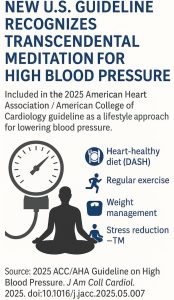
The new guidelines from the American Heart Association and American College of Cardiology strongly recommend lifestyle changes for all adults to prevent and treat high blood pressure. TM is now listed alongside diet, exercise, weight control, and other healthy lifestyle behaviors, with potential applicability to tens of millions of Americans.
The guidelines state: “In adults with or without hypertension, stress reduction through transcendental meditation may be reasonable to prevent or treat elevated BP and hypertension, as an adjunct to lifestyle or medication interventions.”
“This is a landmark acknowledgement,” said Robert D. Brook, MD, Professor of Medicine at Wayne State University and past chair of the AHA scientific statement on alternative approaches to blood pressure.
* * *
The banner image is an AI-generated image used for illustrative purposes, not a photo of actual study participants.
Resources
Click here for the comment in Nature Reviews Cardiology, here for Nature’s “Behind the Paper” social media post by Dr. Schneider, and here for the full AHA/ACC guideline.