

Improving how MIU works: How the Operational Excellence team is helping strengthen the university
For students at MIU, finding the information they needed wasn’t always easy.
Pictured above: Leslie Ciuppa, Nahom Abegaze, Debora Cenatori, Samantha Vento, and Suchanuch Sornsri
Information about housing, financial aid, advising, dining, wellness services, and campus life was scattered across multiple websites, emails, and disconnected systems. Students sometimes encountered broken links, conflicting instructions, or outdated information.
Behind every good student experience is a network of systems, processes, and dedicated people working together. But how could MIU make that network work more seamlessly?
That’s where the university’s Operational Excellence (OpEx) team came in.
Rather than simply renewing an aging student app, the team brought together Student Life, IT, Digital Transformation, and other departments to rethink how students find information and connect with the university.
“Student feedback was essential in developing the Hub from the very beginning,” said Monica Griffiths, Residential Life and Communications Manager in the Student Life Department. “We wanted to build something sustainable that could grow alongside changing needs, rather than become another outdated resource.”
“Student feedback was essential in developing the Hub from the very beginning. We wanted to build something sustainable that could grow alongside changing needs, rather than become another outdated resource.”
— Monica Griffiths
The result was the Student Hub, a secure online home bringing together student resources, communications, events, forms, and support services.
And there was an additional benefit: The team discovered that MIU could build the Hub using technology it already owned, eliminating more than $10,000 in annual software expenses and avoiding a costly multiyear vendor commitment.
The project illustrates what Operational Excellence is all about: bringing people together, identifying the underlying causes of problems, and finding solutions that make MIU work better for everyone.
“We do not come in with the belief that we have all the answers,” said Leslie Ciuppa, Vice President of Operational Excellence. “We bring people together, help them see the whole picture, and work alongside them to develop a solution they can own.”
Building the foundation
Operational Excellence was created to help MIU address challenges that extend beyond individual departments. Its mission is to strengthen the systems, processes, communication, and collaboration that enable employees to do their best work and students to receive the support they need.
The department brings together five complementary specialties: continuous improvement, project management, enterprise communications, data analytics, and operational leadership.
For Nahom Abegaze, Director of Continuous Improvement, the work is about helping people see hidden connections.
“What excites me most is the opportunity to step back, see how the pieces of MIU fit together, and help turn complexity into systems that work better for the people who rely on them,” he said.
The team’s approach reflects a principle familiar throughout MIU: “Water the root to enjoy the fruit.” By addressing underlying causes rather than simply treating symptoms, OpEx helps create conditions in which people and departments can flourish.
From backlogs to breakthroughs
One example of this approach comes from Human Resources.
Working together, HR and OpEx examined how employee requests were received, assigned, tracked, and resolved. They introduced clearer procedures, shared expectations, training, and practical routines for managing the work.
The results were striking.
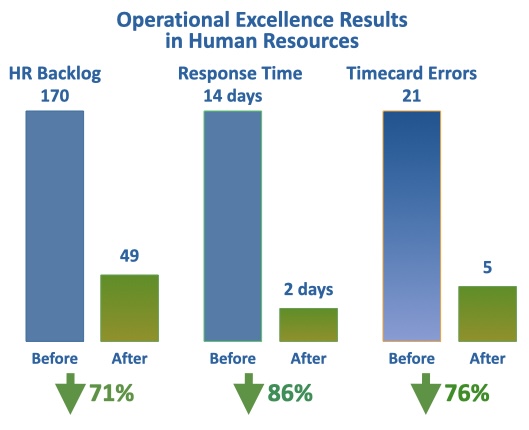
By the end of 2025, HR’s backlog had fallen by 71 percent, from more than 170 requests to 49. Typical response times dropped from approximately two weeks to two days. Timecard errors, once averaging about 21 per pay period, fell to five and were subsequently reported as approaching zero.
HR also established 28 standardized operating procedures to sustain the improvements.
Perhaps most important, the HR team developed the tools and practices to continue improving its own operations, with less direct support from OpEx.
Creating a digital front door for employees
Employees faced challenges similar to those of students.
Policies, forms, announcements, and other resources were scattered across emails, websites, and individual departments. Important information could be difficult to locate, especially months after it had first been distributed.
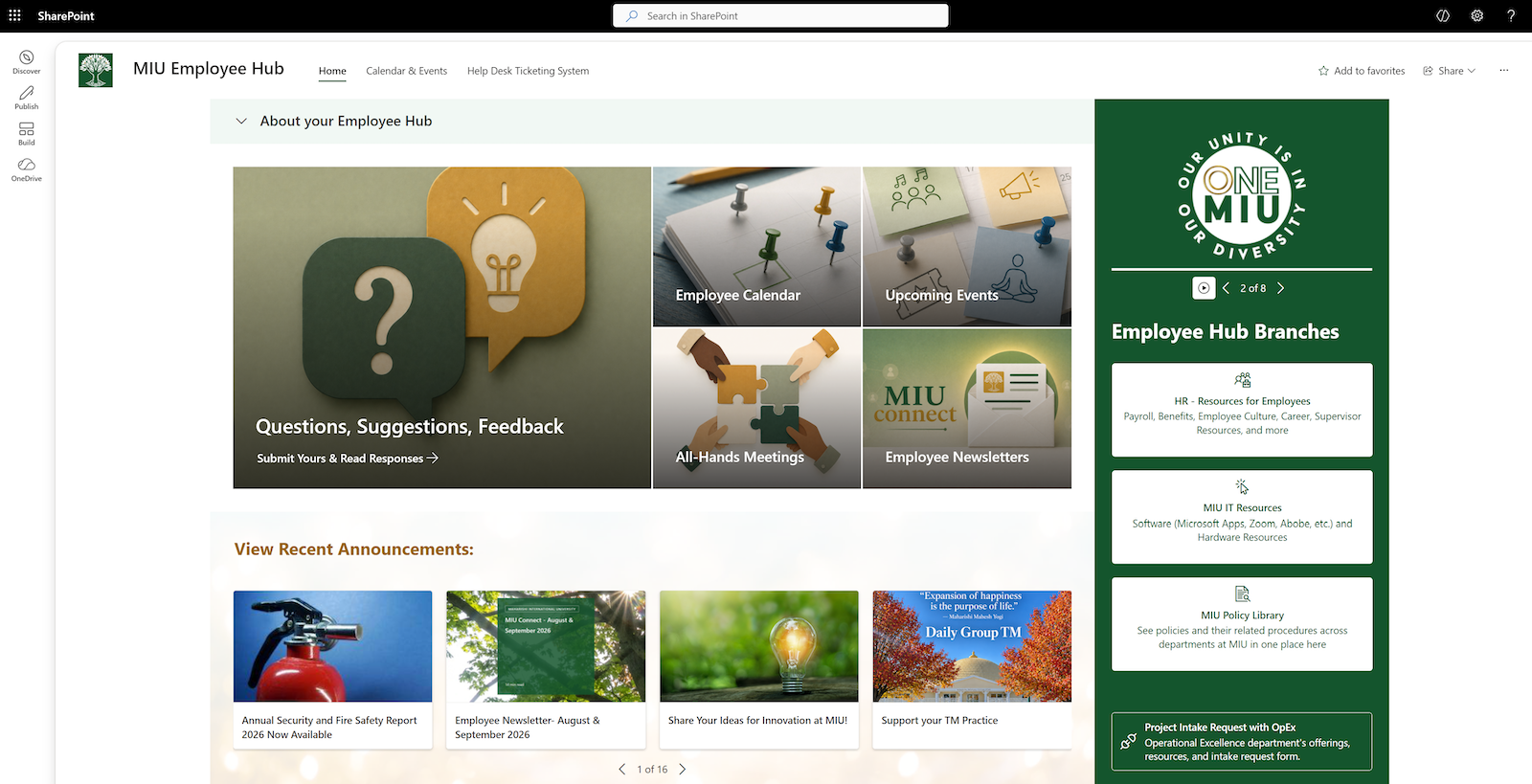
Working with departments across the university, OpEx developed the Employee Hub, MIU’s SharePoint-based intranet and central home for employee information.
What began as a communications initiative has grown into a connected network of resources, including HR and IT information, the MIU Policy Library, and developing faculty resources.
For Samantha Vento, Enterprise Communications and Strategic Projects Coordinator, the project reflects a larger principle.
“Communication is the connective tissue that joins diverse parts into one coherent, flowing whole.”
— Samantha Vento
“Communication is the connective tissue that joins diverse parts into one coherent, flowing whole,” she said. “What inspires me most is seeing how seemingly small but intentional improvements can enhance our shared experience over time.”
Helping departments build on their strengths
OpEx’s work extends well beyond these projects.
The team has helped Athletics and Consciousness-Based Sports strengthen its operating practices, clarify responsibilities, and coordinate activities ranging from recruiting to student support.
It has also helped guide the implementation of new university systems, including Modern Campus for academic catalogs and curriculum processes and Bloomerang for donor relationships and fundraising.
For Debora Cenatori, Director of the Project Management Office, this work is deeply personal.
“I love MIU and this community, and I am deeply committed to its success,” she said. “It is a great honor and joy to work alongside the dedicated people of MIU, helping each individual and department bring their unique excellence into action.”
Looking ahead
Some of OpEx’s most ambitious work is still ahead.
A major priority is helping guide MIU’s transition from CAMS to Elements, a next-generation higher education platform intended to connect admissions, student engagement, communications, and institutional data.
The transition offers opportunities to reduce manual work, improve access to information, and create a more seamless experience for students from their first inquiry through graduation.
Other priorities include expanding institutional dashboards to support decision-making and strengthening how university technology systems are evaluated and managed.
Suchanuch Sornsri, Data and Strategy Analyst, sees data as an important part of that future.
“It’s all about connecting the dots so every department feels empowered to refine their processes and better support our students.”
— Suchanuch Sornsri
“Data is at its best when it tells a human story rather than sitting in complex spreadsheets,” she said. “It’s all about connecting the dots so every department feels empowered to refine their processes and better support our students.”
Empowering employees
For Ciuppa, the real goal is about people — helping them discover better ways to collaborate, build on each other’s strengths, and gain greater confidence in their ability to make a difference.
“My vision is to empower every MIU employee to make things better,” Ciuppa said. “Success means not only solving today’s problems but also giving people the skills and confidence to make lasting improvements. By helping employees improve the way MIU works, we’re helping the university fulfill its mission more effectively.”