Can large group meditation practice reduce hurricane landfalls?
For two straight years, 2004 and 2005, the Atlantic Ocean battered the Eastern U.S. coast with seven major hurricanes (Category 3 or higher) — the most in any two years since 1851, when reliable data-keeping started.
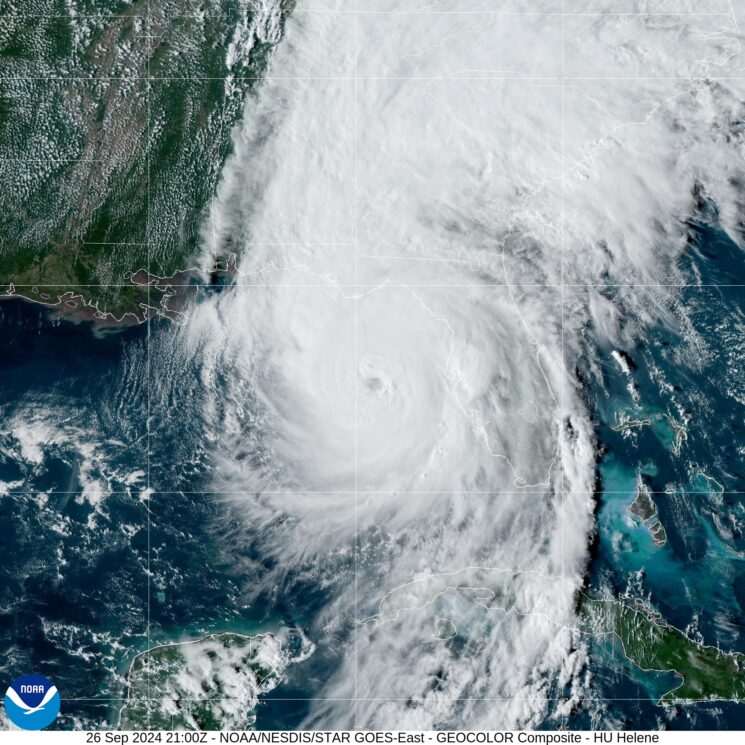
Pictured above: A NOAA satellite view of a massive Hurricane Erin churning off the U.S. East Coast on Aug. 20, 2025. Image credit: NOAA Satellites
It was also the only time that five or more hurricanes of any strength made U.S. landfall in consecutive years. In 2005 alone, four major hurricanes struck — the highest single-season total on record.
At the beginning of 2006, meteorologists naturally predicted another severe hurricane season.
But that year, no hurricanes, major or minor, struck the U.S. — the only year since 1851 that the number of major hurricanes hitting the U.S. dropped from four to zero.
“It was almost like we had a hurricane repellent”
This was no one-year wonder. No major hurricanes struck the U.S. for the next nine years.
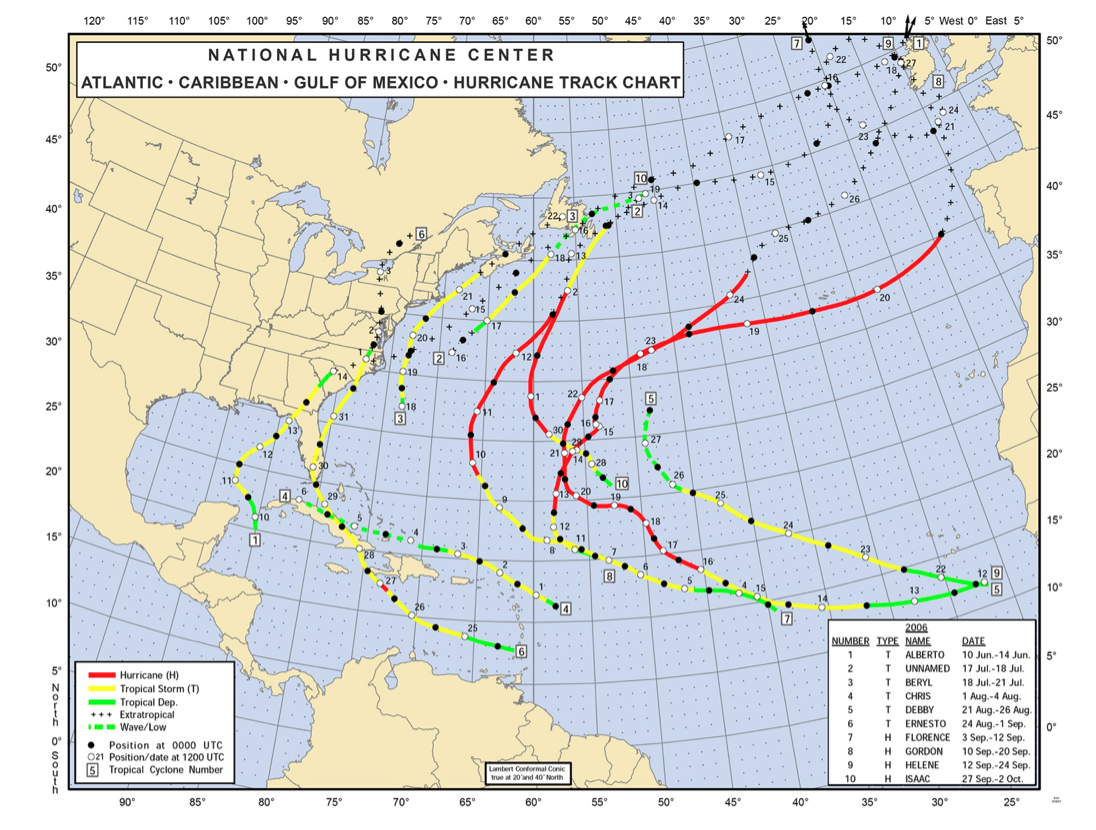
One of those years, 2010, was a particular standout. Twelve hurricanes spun out of the Atlantic basin — five of them major — but none landed. Low-pressure systems kept the storms at sea. Nothing like this had been seen before.
“This was a strange, strange season,” one meteorologist said in a story in National Geographic. “It was almost like we had a hurricane repellent over the U.S. East Coast and Gulf Coast. The storms were out there, but they just didn’t approach the U.S.” (See map below)
Over the nine years from 2006 to 2014, eight minor hurricanes — but no major hurricanes — made landfall in the U.S.
Weather experts describe that nine-year period, 2006–2014, as a hurricane drought — a historically unprecedented event expected to occur only about once every 177 years.
How to explain this?
Weather scientists have been at a loss to account for what happened.
But a recently published statistical study, reviewing 171 years of hurricane records, found a striking pattern: the nine‑year reduction in the annual incidence of landfalling hurricanes coincided with large group practice of Transcendental Meditation (TM) and its advanced programs at MIU in Iowa.
The study was conducted by MIU scientist Dr. Kenneth L. Cavanaugh and Dr. Lee Fergusson, an MIU PhD graduate, professor at Maharishi Vedic Research Institute, and educational researcher at the University of Southern Queensland, Australia.
Human activity affects the weather
Scientists have long accepted that human behavior affects weather and climate through physical means. Industrial chemicals such as chlorofluorocarbons have altered the ozone layer, and greenhouse gas emissions are widely understood to intensify storms and rainfall.
But the new study addresses a more controversial question: whether human consciousness itself might also play a role.
“We asked whether subtler forms of human behavior — particularly collective meditation — could beneficially influence environmental outcomes.”
— Dr. Ken Cavanaugh
“Modern science already recognizes that human activity shapes weather,” Dr. Cavanaugh points out. “We asked whether subtler forms of human behavior — particularly collective meditation — could beneficially influence environmental outcomes.”
Other researchers have explored this idea. For example, in a study entitled “Wishing for Good Weather: A Natural Experiment in Group Consciousness,” Princeton University’s Engineering Anomalies Research (PEAR) lab analyzed 36 years of weather data to compare rainfall in Princeton with rainfall in nearby communities — and found that there was significantly less rain, and less often, in Princeton on days with major outdoor activities, such as graduation, suggesting a possible association between group expectations and weather outcomes.
A prospective demonstration project
A large group began practicing Transcendental Meditation and its advanced techniques daily at MIU in 2006, following the devastating 2004 and 2005 hurricane seasons. One purpose of this prospective demonstration project was to reduce the frequency and intensity of hurricanes striking the continental United States.
The group grew to roughly 1,700 participants — the theoretical threshold the researchers say is needed to influence national trends — and remained in place for the next nine years.
Using interrupted time‑series analysis, the study found that, controlling for other variables, the average number of U.S. landfalling hurricanes dropped sharply during the 2006–2014 period, falling to about 0.7 per year compared with a long‑term baseline of roughly 1.7. This is a reduction of 57.7% from the pre-demonstration period, 1851–2005.
“When we controlled for conventional predictors like storm energy and total Atlantic activity, the decline remained highly significant.”
— Dr. Lee Fergusson
“When we controlled for conventional predictors like storm energy and total Atlantic activity, the decline remained highly significant,” Dr. Fergusson said. “The timing aligns closely with the period of sustained group practice.”
According to Dr. Cavanaugh, the probability is less than 1 in 100 million that these results would be observed if the true effect of the meditation group were actually zero.
The experiment ends — and the major hurricanes return
Notably, after the group program ended in 2015, the pattern reversed — hurricane landfalls and damages increased again, rising 51.2% relative to the demonstration period.
This included the catastrophic 2017 season, when the U.S. was struck by a succession of devastating storms — Harvey, Irma, and Maria — that caused widespread destruction across Texas, Florida, Puerto Rico, and the Caribbean. The season was one of the costliest on record, with damages exceeding $265 billion.
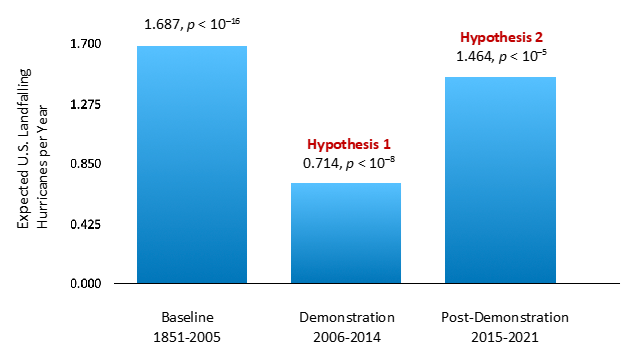
Cavanaugh and Fergusson’s analysis builds on Cavanaugh’s earlier unpublished work. In a 2010 pilot study, he examined NOAA hurricane data from 1851–2010 using similar statistical methods. He found that during the early years of the demonstration period, the number of hurricanes striking the U.S. dropped significantly, with predicted counts falling to more than 60 percent below the historical baseline, after accounting for overall Atlantic storm activity.
Cavanaugh and Fergusson’s study also builds on decades of research into the Maharishi Effect, which has linked large group practice of Transcendental Meditation and the TM‑Sidhi programs with reductions in crime, accidents, and other social indicators. This new analysis extends that idea to the natural environment.
Economic impact: hundreds of billions
In a parallel report, Dr. Howard Settle, CPA, who worked with Maharishi to establish this demonstration project, found a substantial reduction in financial damages associated with this hiatus in landfalling hurricanes.
Analyzing NOAA and federal data, Dr. Settle found that hurricane damage averaged just $18.9 billion per year during the 2006–2014 period — less than half the pre‑2006 average and far below the $77.1 billion annual average seen after 2015.
By comparison, the study estimates that the “quiet” years produced $240 billion in avoided losses, while a return to higher storm activity after 2015 resulted in more than $500 billion in additional costs relative to that benchmark.
“These were not just statistical differences — they translated into real economic relief.”
— Dr. Howard Settle
“These were not just statistical differences — they translated into real economic relief,” Settle said. “Insurance markets stabilized, rebuilding could proceed uninterrupted, and communities had time to recover.”
Competing explanations
Mainstream meteorology has struggled to fully explain the drought. Standard factors such as El Niño cycles, Atlantic temperature patterns, and storm intensity do not account for the sharp drop in U.S. landfalls during those years, according to the study.
Lacking a persuasive explanation from conventional atmospheric science, some prominent hurricane experts simply attribute the drought to “luck.”
For example, two leading experts pointed out that this long stretch without major U.S. hurricanes is surprising. During many of those years, there were still lots of storms, including strong ones, and several hit the Caribbean. In other words, hurricane activity was high — but the U.S. was largely spared. They suggested that current weather science doesn’t fully explain this pattern, and that it would take new ideas to understand how storms could stay active while mostly missing the U.S. but damaging nearby regions.
A broader hypothesis
Cavanaugh and Fergusson acknowledge that the findings are consistent with — but do not prove — causation. But they are consistent with predictions of the Maharishi Effect theory.
This type of study is known as a quasi-experiment. In such studies, researchers introduce an intervention or program but do not randomly assign participants — in contrast to natural experiments, where they retrospectively analyze data on events that unfolded without deliberate intervention. Because the intervention is planned, quasi-experiments often allow researchers to predict outcomes in advance and then test whether those predictions are borne out.
At the core of this research is a broader theoretical framework drawn from Vedic tradition, which proposes that individual and collective consciousness are interconnected with the natural environment. In that model, large‑scale stress in society can foster imbalance in nature, while coherence — enhanced through practices such as meditation — can neutralize stress and promote stability.
“We are not claiming that consciousness directly ‘controls’ the weather,” they say. “But the data are consistent with the hypothesis that reducing collective stress may influence how natural systems behave.”
“This hypothesis challenges conventional thinking,” Cavanaugh said. “But history shows that science advances by investigating anomalies, not ignoring them.”
Given these results, Cavanaugh and Fergusson urge public and private organizations to support replicating this evidence-based approach to mitigating disasters.
For further information
Click here to read the study, “Consciousness and the Environment: Maharishi Technologies of Consciousness and the Incidence of U.S. Landfalling Hurricanes, 1851–2021,” published last December in the Journal of Scientific Exploration.
Click here to read Dr. Howard Settle’s “US Hurricane Damage Analysis 1997–2023.”