
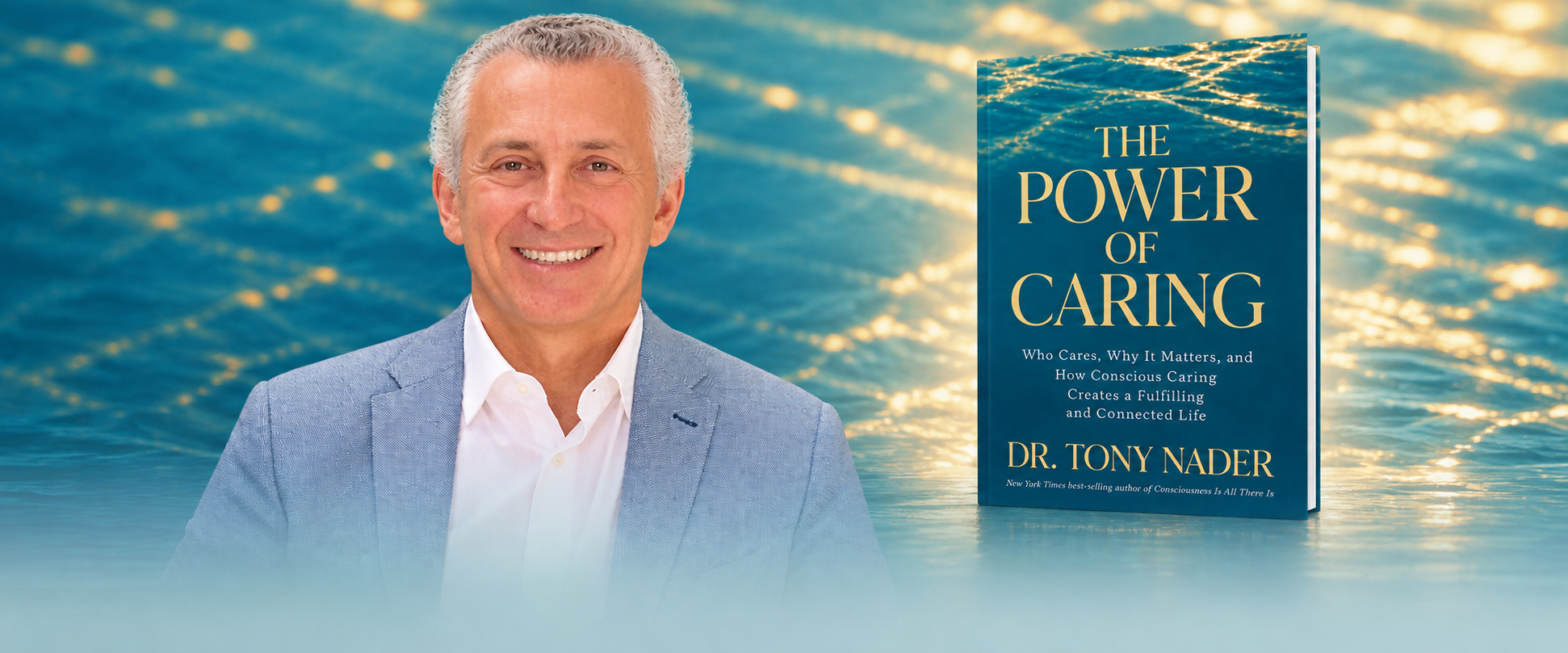
President Nader’s new book, The Power of Caring, earns best-seller status, national awards, and growing media attention
Since its release on July 28, The Power of Caring by Dr. Tony Nader has gained significant national and international attention, earning places on two major bestseller lists, receiving four book awards, and generating a growing stream of media coverage, interviews, and podcast discussions.
Published by Hay House, The Power of Caring became both a USA Today and Los Angeles Times bestseller. The book has also received four major awards: Gold honors from the Living Now Book Awards and Global Ebook Awards, a PenCraft Book Award, and the Literary Titan Gold Book Award.
The book’s central message is that fulfillment comes not from caring more, but from caring better. Nader introduces the concept of “conscious caring,” which emphasizes compassion, healthy boundaries, and inner balance rather than anxiety, over-responsibility, or emotional exhaustion.
That message helped earn the book a five-star review from Literary Titan, which praised The Power of Caring as an expansive exploration of caring that draws on biology, philosophy, relationships, work, grief, technology, environmental concerns, and spiritual life. The review highlighted one of the book’s central themes: the importance of learning to “care better” rather than simply “care more.”
Prominent media appearances
The book’s visibility has been further amplified through a series of prominent media appearances. One of the book’s highest-profile media appearances came in late August, when Dr. Nader appeared on CNN International’s One World. During the interview, he discussed how people can remain deeply engaged with the needs of others while maintaining their own balance and well-being.
Earlier this year, Nader outlined the book’s core ideas in an article published by Medium Magazine. There he argued that many people become emotionally overloaded not because they care too much, but because they confuse caring with anxiety, control, or excessive responsibility. Conscious caring, he wrote, allows people to maintain compassion and connection while preserving their own energy and resilience.
Several widely heard podcast interviews also explored the book’s themes. On the popular Dharmic Life / BAPS Better Living podcast, Nader examined loneliness, distraction, the biology of caring, and the relationship among self-care, love, meditation, and human flourishing. He emphasized that lasting caring requires an inner foundation rather than simply giving more of oneself away.
Another notable appearance came on Your Thoughts Your Reality, where the discussion focused on trauma, veterans, first responders, emotional resilience, and belonging. During that interview, Nader drew a distinction that has become one of the book’s recurring themes.
“Caring means ‘I see you, I’m here, I’ll help where I can, and I know your life is yours to live,'” he said. Carrying, by contrast, involves assuming responsibility for another person’s outcome and feeling compelled to solve their problems.
“Caring means ‘I see you, I’m here, I’ll help where I can, and I know your life is yours to live.'”
— Dr. Tony Nader
To extend these conversations beyond the book itself, Nader launched the podcast Depth Over Noise in early July. The series explores what he describes as the ten major themes underlying The Power of Caring, including purpose, relationships, burnout, leadership, personal transformation, and well-being.
The inaugural episode, “Choosing to Care When Life Gives You Every Reason Not To,” featured bestselling author Hal Elrod, who reflected on surviving two life-threatening experiences and the deliberate choice to continue caring rather than becoming cynical. Their conversation explored how daily practices can restore purpose and engagement even during difficult periods.
Subsequent guests have included Dwayne J. Clark, founder and CEO of Aegis Living, who discussed “Caring Across a Lifetime” — aging, caregiver burnout, elder care, and leadership.
Another episode featured author and researcher Steven Kotler, whose conversation with Nader on “Flow, Neurobiology, and the Science of Caring,” explored empathy, flow states, intuition, neurobiology, and the implications of artificial intelligence. Together they examined the idea that caring has measurable biological and neurological foundations and should not be viewed solely as a moral or philosophical concept.
The value of Transcendental Meditation practice for caring
Throughout these interviews and discussions, Nader has consistently emphasized that the Transcendental Meditation technique plays a central role in developing what he calls conscious caring.
“Overall, the book really defines caring to be something that comes from the inside,” he said in a recent interview. “That’s what I differentiate: just general caring, empathy, and compassion from conscious caring. Conscious caring is something that comes from within.”
Reflecting on the book’s broader purpose, he added, “I’d love the book to be in the hands of everyone because we all care, we are humans. It’s only a matter of allowing that inner value to blossom, and that is what the book teaches.”
With national bestseller recognition, multiple independent awards, an expanding media presence, and a new podcast dedicated to exploring its themes, The Power of Caring continues to bring Nader’s message of conscious caring to an increasingly broad audience.