

MIU researchers find Transcendental Meditation brings measurable benefits to rural Lebanese women
For many women in Lebanon’s rural Chouf region, stress isn’t something that comes and goes. It’s part of daily life. Economic hardship, political uncertainty, environmental challenges, and family responsibilities can create a constant stream of pressure.
Researchers wondered whether the simple practice of Transcendental Meditation might help.
According to a study published in Women’s Health, it did.
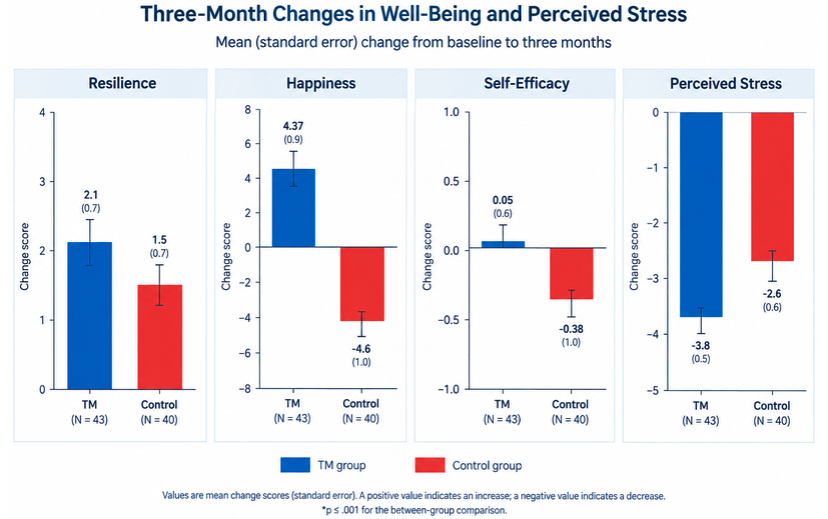
Women who learned the Transcendental Meditation technique reported greater happiness, resilience, and confidence in their ability to handle life’s challenges, along with lower levels of stress, after just three months of practice.
The women were divided into two groups. One learned the Transcendental Meditation technique, while the other received weekly videos focused on personal development and well-being. After three months, the differences were clear. Compared with the control group, women practicing Transcendental Meditation reported higher levels of happiness, resilience, and self-efficacy, along with lower levels of perceived stress.
“This is very encouraging because it shows the women improved across several dimensions of psychological well-being at the same time.”
— Marie Loiselle, principle investigator
“This is a significant study considering the methods: a randomized controlled trial with 114 subjects and statistically significant improvements in every measure,” said Marie Loiselle, PhD, principal investigator and researcher in MIU’s Department of Maharishi Vedic Science. “This is very encouraging because it shows the women improved across several dimensions of psychological well-being at the same time.”
Happiness showed the biggest improvement
Of all the outcomes researchers tracked, happiness showed the largest improvement. Women in the Transcendental Meditation group reported increased happiness after both one month and three months of practice. By contrast, the control group showed a small increase after one month, followed by a substantial decline at three months.
The researchers also found that women who felt more capable of handling life’s challenges tended to report greater happiness. Lower levels of stress were also closely linked to higher happiness levels. Together, these factors accounted for nearly half of the differences in happiness scores among participants.
In simple terms, self-efficacy is a person’s belief that they can successfully deal with challenges and achieve desired results. The study found that this sense of capability increased among women practicing Transcendental Meditation while declining in the control group over the same period.
Strong participation in the practice
Participants were encouraged to practice Transcendental Meditation for 20 minutes twice a day. Participation remained high throughout the study. Sixty percent reported practicing twice daily every day or most days, 18% practiced once daily, and 20% practiced less regularly. No harmful effects related to participation were reported.
Because the study compared Transcendental Meditation with another structured activity focused on personal growth and well-being, researchers could evaluate whether the observed changes were associated with the meditation practice itself rather than simply participating in a supportive program.
“The improvements in self-efficacy and reductions in perceived stress are particularly important because both were related to happiness in our analysis.”
— Fred Travis, co-author
“The improvements in self-efficacy and reductions in perceived stress are particularly important because both were related to happiness in our analysis,” said Fred Travis, PhD, statistician, co-author, and senior advisor on the study. “These findings provide a basis for further research into approaches that may help people cope with persistent environmental stress.”
Inspired by the experiences of local women
The research was conducted in collaboration with the Ladies Foundation for Pure Knowledge, which was nearing completion of a project to teach the Transcendental Meditation technique to approximately 1,000 women in the Chouf region.
After hearing many participants describe positive changes in their lives, the foundation wanted to know whether those experiences could be measured scientifically.
“So many of the participants told me their lives had been transformed in many ways that words could not even begin to describe,” said Susan Hamza, the foundation’s director. “We are deeply grateful for all those who were involved in realizing this project.”
Further research needed
The researchers advise that larger and longer-term studies are needed to confirm the findings. Of the 114 women who initially enrolled, 83 completed both post-study assessments, and participants were followed for three months. The researchers recommend future studies involving larger populations and follow-up periods of six months to a year in Lebanon and elsewhere in the Middle East.
Still, the findings provide early evidence that a simple, twice-daily meditation practice may offer meaningful support for women facing persistent stress in their daily lives.