
MIU celebrates class of 2026 with a call to “Be the bridge”
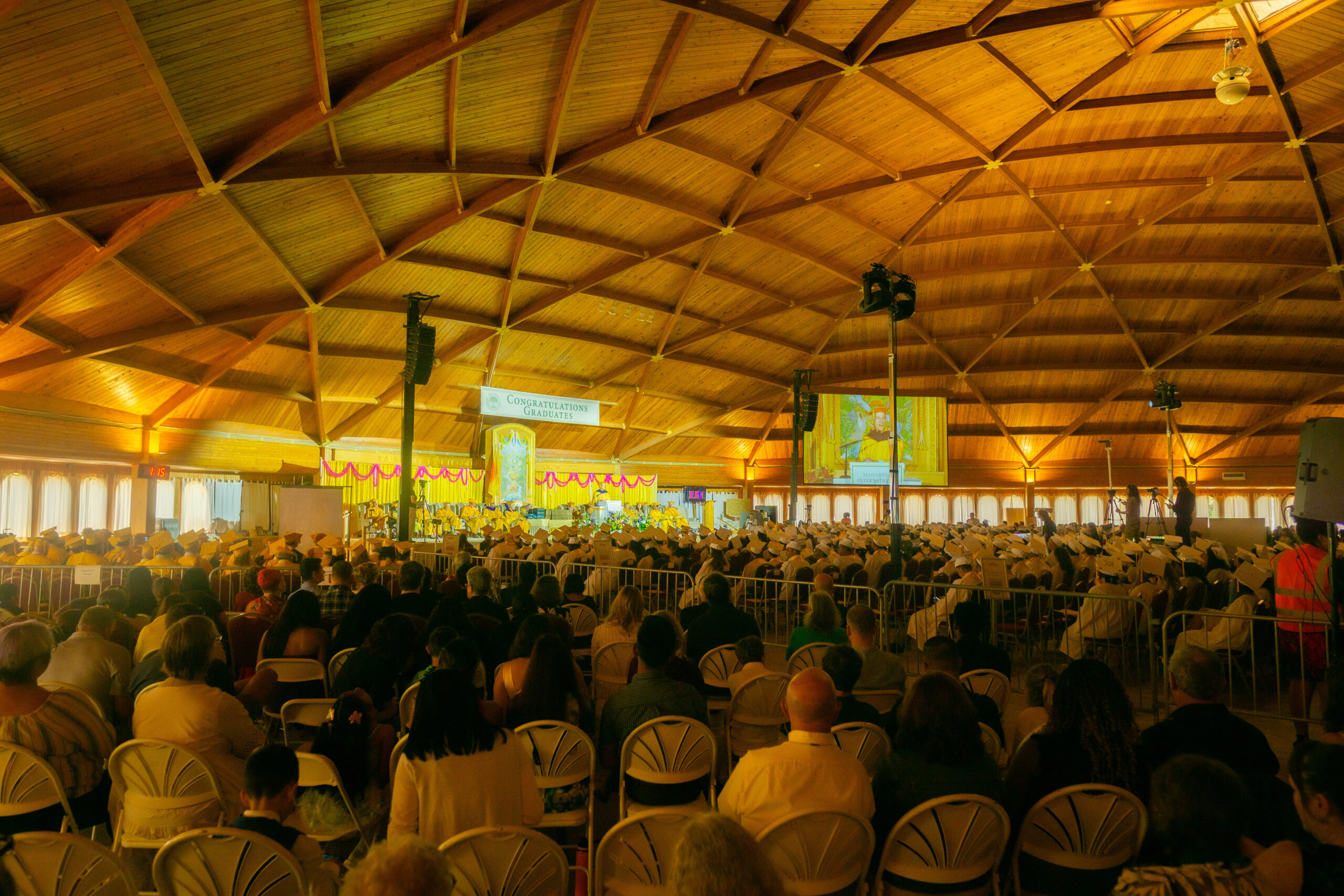
On a warm and sunny Saturday afternoon, June 20, MIU conferred degrees on 679 graduates at its 2026 commencement ceremony, with graduating students representing 55 countries. Altogether, MIU awarded 159 bachelor’s degrees, 493 master’s degrees, 26 Masters of Fine Arts degrees, 30 doctoral degrees, and two honorary doctorates.
Click here to see the full commencement ceremony as well as videos of the key speeches.
The ceremony opened with recognition of the broader community behind the graduates’ achievements, appreciating parents, families, and friends — many of whom had traveled long distances, including from outside the United States — as integral to the students’ success.
“I encourage you to stay in touch with joy” — Dr. Pedro Noguera’s commencement address
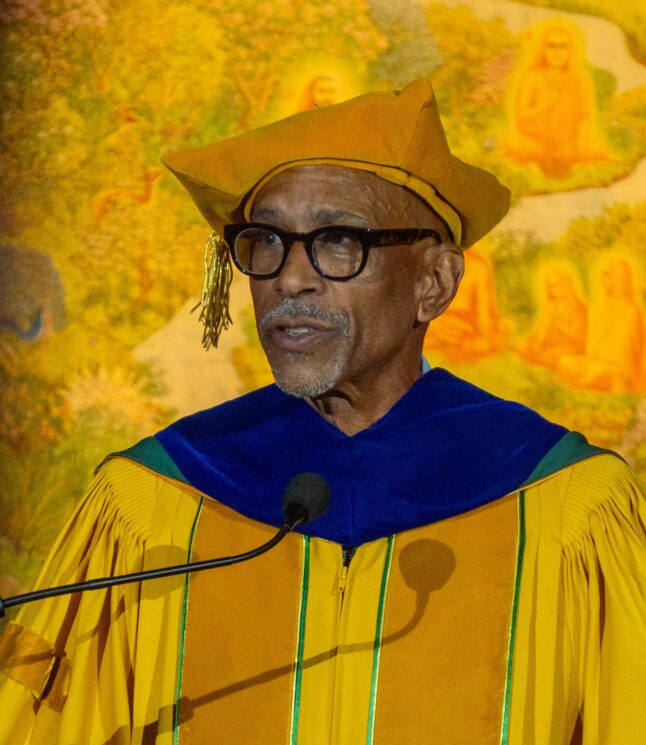
Dr. Pedro Noguera, Dean of the USC Rossier School of Education, delivered a spirited commencement address.
He highlighted the urgency of issues such as climate change, political polarization, and economic inequality — yet he invited graduates to reframe these challenges as “learning challenges.” Then, he said, “The problems become less daunting and
insurmountable. We must simply learn how to address them.”
“I believe education is not only the best tool we have for creating a better future — it may be all we have,” he said. “The human ability to adapt and learn has proven to be our superpower.”
“Unlike humans, AI can’t think outside the box,” he said. “We have the ability to use education, compassion, and our ability to innovate, to imagine new alternatives, to uplift humanity and protect our Mother Earth.”
“We are the ones we’ve been waiting for,” he said, quoting the Hopi elders’ teaching.
He described how, as a university student, he traveled to war-torn El Salvador to negotiate the release of a political prisoner, a student leader at a university. While waiting in a dark waiting room, he inadvertently walked into one of the prison areas. “I was shocked to see how close I was to the men behind bars, who looked upon me with curiosity.”
He got to talking with one of them, who said, “When I get out, I’m going to celebrate” — and though no music was playing, “he proceeded to show me some impressive dance moves.” And they both laughed.
“I thought, if that man could joke about dancing even while facing the cruelty of imprisonment under a military dictatorship,” Noguera said, “couldn’t I find a way to maintain a sense of joy?”
“Graduates,” he then said, “I encourage you to stay in touch with joy, to maintain a lightness of spirit, a smile on your face, and even a little dance in your step, so that you can counter the forces of negativity and doom with compassion, kindness, and love.”
He quoted the Sufi poet Rumi, “Love is the bridge between you and everything” — then said to the graduates: “Be the bridge.”
“The Maharishi Effect is real,” he said. “We can change the world by changing ourselves, and small actions do add up and have effects that we may not perceive at the moment, but nonetheless ripple into the universe. You have the power to be a force of good in the world, and the world needs that now more than ever.”
“Class of 2026,” he concluded, “I hope you do well, I hope you do good, and I hope you have some fun while you do both. All the best.”
President Nader honors Dr. Noguera
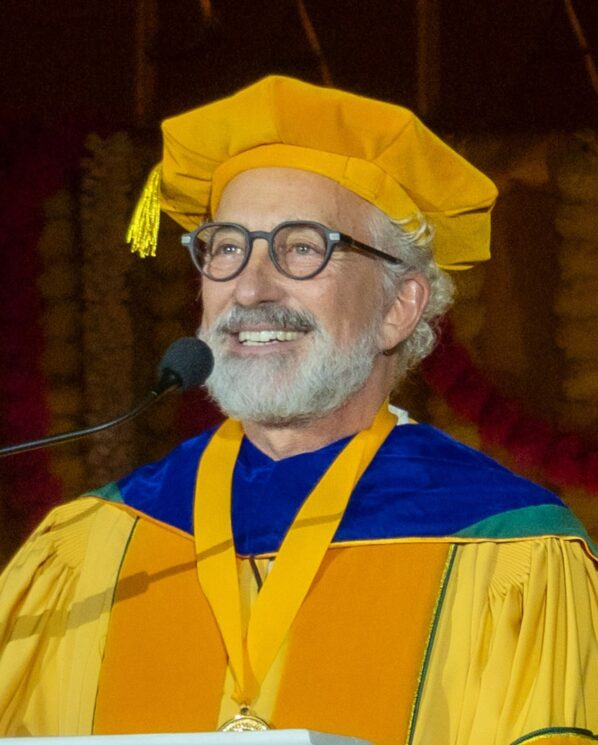
“You have given us more than a commencement address,” President Nader said, reflecting on Noguera’s address. “You have given us a benediction.”
Nader underscored three key ideas from Noguera’s speech: the urgency of personal responsibility, the sustaining power of joy and love even in adversity, and the metaphor of being a bridge between seemingly separate worlds. “There are moments,” he said, “when the line from the Hopi elders, ‘We are the ones we have been waiting for,’ ceases to be inspirational and becomes simply true. This is one of them.”
He also reflected on the deeper significance of the “be the bridge” metaphor. “That, in three words, is the entire mission of this university,” he said. “We have spent decades preparing young people to be exactly that. Bridges between cultures, between disciplines, between the inner life and the outer work. You have given them a single sentence to carry with them. They will carry it.”
MIU President Dr. Tony Nader presented Dr. Noguera with the degree of Doctor of Education honoris causa, honoring his lifetime of service to humanity through education.
Professor Amine Kouider, representing the Board of Trustees, then presented a second honory degree, a Doctor of Fine Arts honoris causa, to MIU graduate and Fairfield resident Dick DeAngeles, for his lifelong service to Fairfield and MIU and especially for his award-winning eight-part History of Fairfield video documentary series.
“MIU was never meant to be ordinary” — valedictorian address
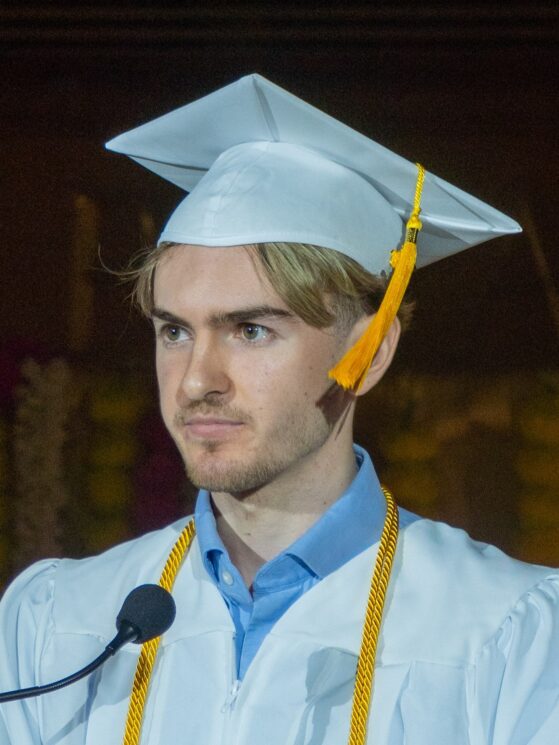
Valedictorian Polo Altinsky-Ross described MIU as consistently exploring ideas ahead of their time. Long before concepts such as wellness, sustainability, and human-centered development became mainstream, he noted, they were already central to the MIU’s approach.
“MIU is not easy to explain,” he said, “because it was never meant to be ordinary.” MIU challenges conventional assumptions about higher education by combining academic rigor with daily practices aimed at developing consciousness.
He argued that MIU’s focus on human development is becoming increasingly relevant. “A more advanced society is not just one with better machines,” he said, “but one with better people — clearer, more balanced, more compassionate.”
“Established in Being, perform action” — salutatorian address

Salutatorian Chirl Dawn Saylor offered a more personal reflection, describing her educational experience as transformative on multiple levels. Drawing on the Sanskrit phrase Yogastha Kuru Karmani — “established in Being, perform action” — she emphasized the distinction between intellectual understanding and lived experience.
“There is a difference between knowing something and being it,” she said. For Saylor, MIU’s impact lay not in introducing entirely new concepts but in enabling a deeper integration of ideas she had encountered throughout her life. She described her time at MIU as a process of rebuilding “from the inside out,” affecting her health, awareness, and daily experience.
She challenged the notion that inner growth requires withdrawal from the world, instead highlighting the “householder path” — the possibility of pursuing personal development while remaining fully engaged in everyday life. Her remarks underscored a central theme of the ceremony: that inner development and outward action are mutually supportive.
“Do not underestimate your single life” — President Nader’s charge to the graduates
In his closing charge to the graduates, Nader offered them a single unifying concept: care. He described caring as an expression of consciousness itself. “Caring is what consciousness does when it recognizes itself in another,” he said.
He outlined three practical principles to sustain this orientation: distinguishing between caring and becoming overburdened, clarifying daily priorities by asking what is truly one’s responsibility, and recognizing the far-reaching impact of individual actions. “Do not underestimate your single life,” he told graduates, emphasizing that acts of care ripple outward in ways that may not be immediately visible.
Of special note, 16 of the doctoral students graduated from MIU’s PhD program in China, with five of them traveling from China to participate in the ceremony in person. As their class gift, they pledged $50,000 to help promote MIU in China, specifically by having President Nader’s two books — the New York Times best-selling Consciousness Is All There Is and his new book The Power of Caring — translated, published, and promoted in their country.
Click here to see the ceremony, here for more graduation photos, and here video clips of graduating students.
Photos by Dileep Krishnamoorthy