
“Assembly of 10,000 for World Peace” in India shown to reduce violence in high-conflict nations
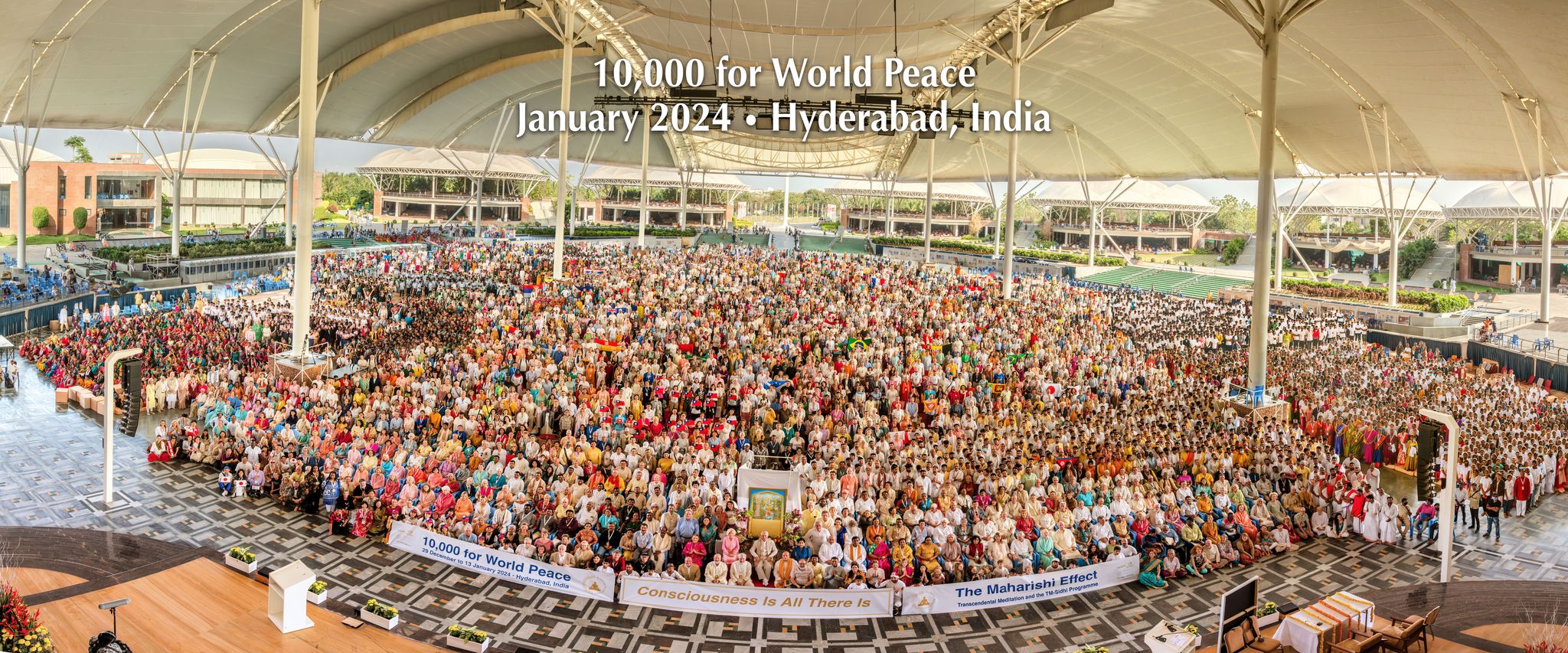
Almost exactly two years ago — from December 29, 2023, to January 12, 2024 — nearly 11,000 people representing 139 countries came together in Hyderabad, India, for a “10,000 for World Peace” assembly.
The assembly had several goals:
- To boost peace and harmony in society during a tumultuous period in history
- To build public awareness of the power of the Transcendental Meditation and TM-Sidhi programs to create this effect
- To inaugurate efforts to create several permanent 10,000 groups in India and Mexico.
The assembly may have succeeded in its first goal, according to new peer-reviewed published research. During the two weeks of the assembly, there were sharp, statistically significant drops in political violence across some of the world’s most conflicted nations — confirming a prediction the researchers had publicly announced in advance.
This outcome is known as the Maharishi Effect.
The underlying premise is that large meditation groups reduce social stress, thereby reducing social violence and disorder. According to the theory, the Maharishi Effect becomes objectively measurable when the size of the group equals or exceeds the square root of one percent of a given population. The number 10,000 exceeds the square root of 1% of the world’s population of just over eight billion people.
The research was conducted by Dr. Ken Cavanaugh, Director of Collective Consciousness Research at the Dr. Tony Nader Institute for Consciousness, and Dr. Lee Fergusson, professor of Maharishi Vedic Science, education, and environment, and founding director of the Maharishi Vedic Research Institute in Australia.
This study joins the more than 90 empirical studies conducted on the Maharishi Effect to date.
Focus on world’s most violent countries
To test the prediction, Cavanaugh and Fergusson obtained monthly data on political violence from January 2021 through January 2025 from the Armed Conflict Location & Event Data (ACLED) project, a database widely used in conflict research. According to its website, ACLED is “an independent, impartial global monitor that collects, analyses, and maps data on conflict and protest. ACLED provides detailed information to help identify, understand, and track patterns and trends in conflict and crisis situations around the world.”
Cavanaugh and Fergusson began by focusing on the world’s three countries with the most extreme levels of internal disorder and violence. According to ACLED, those countries were Palestine, Myanmar (Burma), and Syria.
Sharp trend reversal and statistical strength
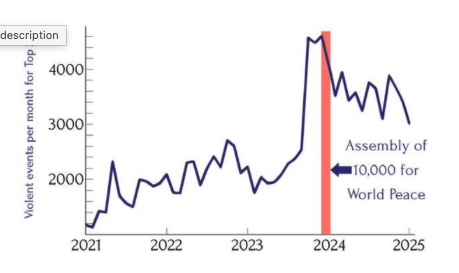
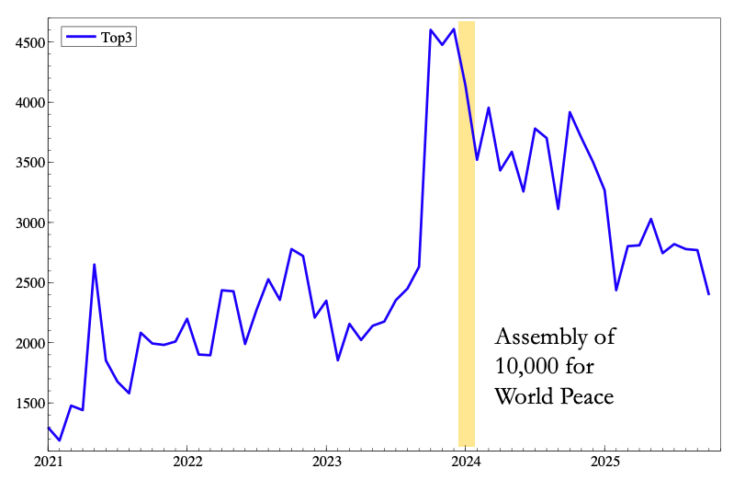
Using state-of-the-art statistical methods, Cavanaugh and Fergusson tracked how monthly violent events changed during and after the Hyderabad assembly. They found that violence across the three countries was rising steeply before the assembly, leveled off around the time of the assembly, and then steadily declined after the assembly, with the decline continuing for another year, through January 2025.
“The data strongly supported the research hypothesis,” Cavanaugh said. “The observed reversal was highly statistically significant, with a p-value of less than 0.001. This means that the chances that this reduction was a fluke are less than one in a thousand.”
Additional data, stronger trend
After the article was published, Cavanaugh and Fergusson expanded the study. They looked at nine additional months of data, through October 2025, and found that the downward trend not only continued but grew stronger — from December 2023 to October 2025, political violence in Palestine, Myanmar, and Syria plummeted 48%.
“This was an even larger and more robust decline than the 29.2% we initially reported,” Cavanaugh said. “A 48% reduction is remarkable in countries that had been experiencing some of the most extreme levels of collective political violence in the world.”
Similar patterns across 30 countries and globally
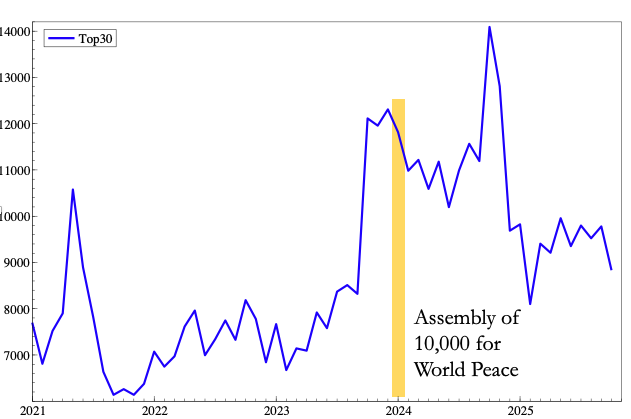
Cavanaugh and Fergusson expanded the study further still. They looked at the 30 countries with the highest levels of internal political violence, again using ACLED data from January 2021 through October 2025.
They found a similar pattern. Monthly violence climbed steeply through 2023, then flattened out and began to decline after the Hyderabad assembly, with only a brief two-month spike in October–November 2024 when group participation in existing large Super-Radiance groups in India dropped during national holidays.
Overall collective violence across these 30 countries fell by 28.2% between December 2023 and October 2025, a highly statistically significant outcome.
What caused these changes? The need for a new paradigm
“The idea that a meditation group in one location could affect violence worldwide challenges conventional scientific assumptions,” Cavanaugh acknowledges. “The dominant materialistic paradigm of modern science can’t plausibly explain these results. But they are consistent with a new theoretical framework in which consciousness is primary.”
This framework derives from Maharishi Vedic Science and the ongoing work of Dr. Tony Nader, which postulates that “consciousness is all there is.”
“The idea is that large meditation groups enliven the universal field of pure consciousness at the basis of society’s collective consciousness,” Cavanaugh said. “This is the simplest, most parsimonious explanation for the wide range of positive societal changes we observe with the Maharishi Effect.”
“Small islands of coherence”
Situating the findings in a broader scientific context, Cavanaugh cites Nobel laureate chemist Ilya Prigogine, who wrote, “When a complex system is far from equilibrium, small islands of coherence in a sea of chaos have the capacity to shift the entire system to a higher order.”
“When a complex system is far from equilibrium, small islands of coherence in a sea of chaos have the capacity to shift the entire system to a higher order.”
— Ilya Prigogine, Nobel laureate chemist
“The assembly of 10,000 for world peace functioned as just such an island of coherence in a world that is clearly far from equilibrium,” Cavanaugh said.
“These results strengthen the case for establishing permanent 10,000 groups in India and other regions as a practical strategy for reducing violence and enhancing societal harmony,” Cavanaugh said. “The science is clear: When we systematically enliven collective consciousness, we can reverse negative social trends — even in the most violent places on Earth.”
Groups in India expanding
After the 10,000 for World Peace Assembly, the number of participants in the Yogic Flying groups throughout India continued to expand. Click here for details about the progress on this project. Presenters include:
- Dr. Tony Nader, Patron of Global Super-Radiance, head of the global Transcendental Meditation organizations, and president of MIU
- Dr. John Hagelin, quantum physicist, researcher, and international president of the Global Union of Scientists for Peace
- Dr. Luis Alvarez, operational director of Super-Radiance programs
- Dr. Alison Plaut, founder and director of the Himalayan Devis project
- Dr. Howard Settle, administrative director of global Super-Radiance programs