
For students at MIU, finding the information they needed wasn’t always easy.
Pictured above: Leslie Ciuppa, Nahom Abegaze, Debora Cenatori, Samantha Vento, and Suchanuch Sornsri
Information about housing, financial aid, advising, dining, wellness services, and campus life was scattered across multiple websites, emails, and disconnected systems. Students sometimes encountered broken links, conflicting instructions, or outdated information.
Behind every good student experience is a network of systems, processes, and dedicated people working together. But how could MIU make that network work more seamlessly?
That’s where the university’s Operational Excellence (OpEx) team came in.
Rather than simply renewing an aging student app, the team brought together Student Life, IT, Digital Transformation, and other departments to rethink how students find information and connect with the university.
“Student feedback was essential in developing the Hub from the very beginning,” said Monica Griffiths, Residential Life and Communications Manager in the Student Life Department. “We wanted to build something sustainable that could grow alongside changing needs, rather than become another outdated resource.”
“Student feedback was essential in developing the Hub from the very beginning. We wanted to build something sustainable that could grow alongside changing needs, rather than become another outdated resource.”
— Monica Griffiths
The result was the Student Hub, a secure online home bringing together student resources, communications, events, forms, and support services.
And there was an additional benefit: The team discovered that MIU could build the Hub using technology it already owned, eliminating more than $10,000 in annual software expenses and avoiding a costly multiyear vendor commitment.
The project illustrates what Operational Excellence is all about: bringing people together, identifying the underlying causes of problems, and finding solutions that make MIU work better for everyone.
“We do not come in with the belief that we have all the answers,” said Leslie Ciuppa, Vice President of Operational Excellence. “We bring people together, help them see the whole picture, and work alongside them to develop a solution they can own.”
Building the foundation
Operational Excellence was created to help MIU address challenges that extend beyond individual departments. Its mission is to strengthen the systems, processes, communication, and collaboration that enable employees to do their best work and students to receive the support they need.
The department brings together five complementary specialties: continuous improvement, project management, enterprise communications, data analytics, and operational leadership.
For Nahom Abegaze, Director of Continuous Improvement, the work is about helping people see hidden connections.
“What excites me most is the opportunity to step back, see how the pieces of MIU fit together, and help turn complexity into systems that work better for the people who rely on them,” he said.
The team’s approach reflects a principle familiar throughout MIU: “Water the root to enjoy the fruit.” By addressing underlying causes rather than simply treating symptoms, OpEx helps create conditions in which people and departments can flourish.
From backlogs to breakthroughs
One example of this approach comes from Human Resources.
Working together, HR and OpEx examined how employee requests were received, assigned, tracked, and resolved. They introduced clearer procedures, shared expectations, training, and practical routines for managing the work.
The results were striking.
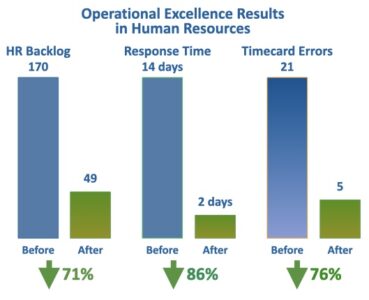
By the end of 2025, HR’s backlog had fallen by 71 percent, from more than 170 requests to 49. Typical response times dropped from approximately two weeks to two days. Timecard errors, once averaging about 21 per pay period, fell to five and were subsequently reported as approaching zero.
HR also established 28 standardized operating procedures to sustain the improvements.
Perhaps most important, the HR team developed the tools and practices to continue improving its own operations, with less direct support from OpEx.
Creating a digital front door for employees
Employees faced challenges similar to those of students.
Policies, forms, announcements, and other resources were scattered across emails, websites, and individual departments. Important information could be difficult to locate, especially months after it had first been distributed.
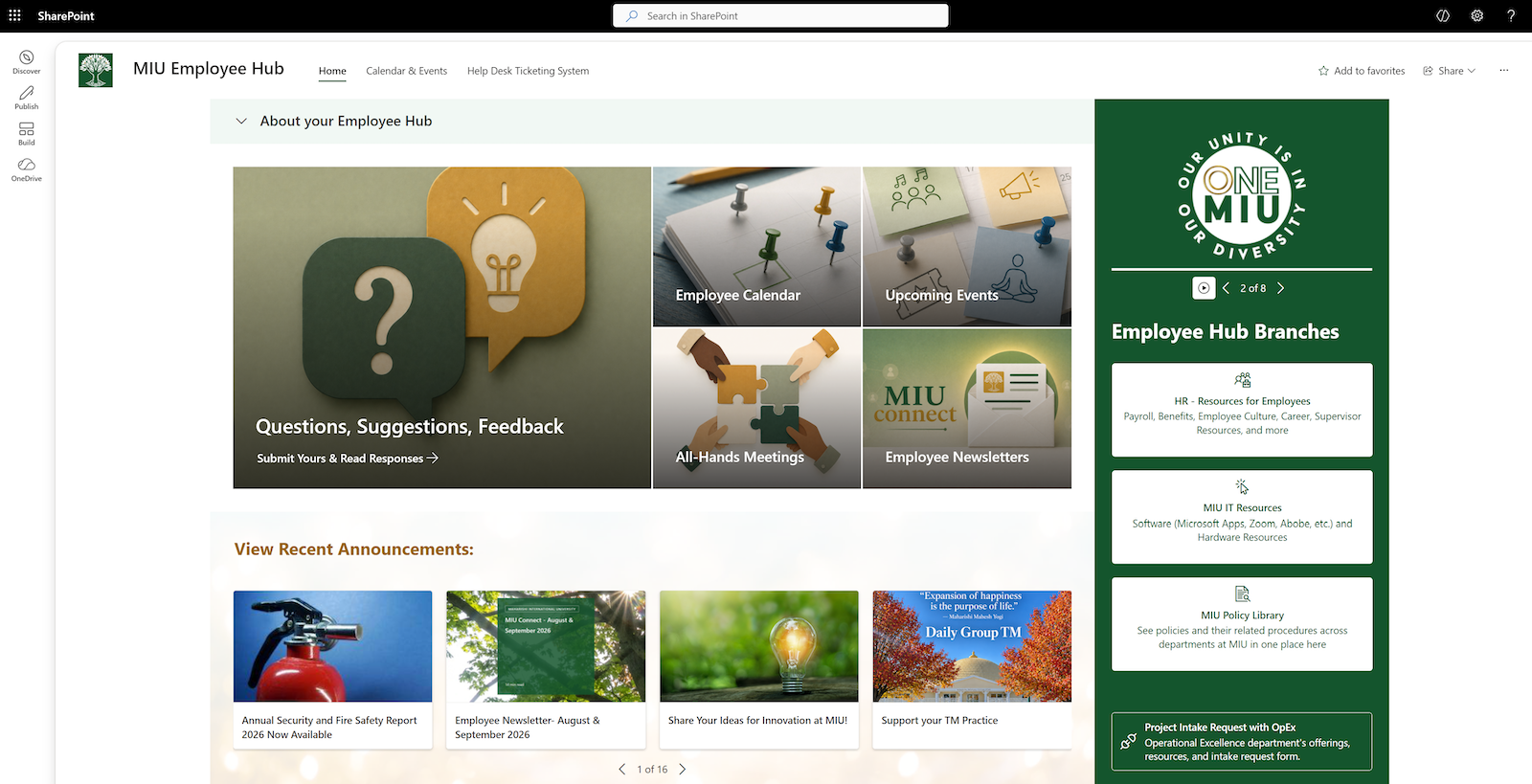
Working with departments across the university, OpEx developed the Employee Hub, MIU’s SharePoint-based intranet and central home for employee information.
What began as a communications initiative has grown into a connected network of resources, including HR and IT information, the MIU Policy Library, and developing faculty resources.
For Samantha Vento, Enterprise Communications and Strategic Projects Coordinator, the project reflects a larger principle.
“Communication is the connective tissue that joins diverse parts into one coherent, flowing whole.”
— Samantha Vento
“Communication is the connective tissue that joins diverse parts into one coherent, flowing whole,” she said. “What inspires me most is seeing how seemingly small but intentional improvements can enhance our shared experience over time.”
Helping departments build on their strengths
OpEx’s work extends well beyond these projects.
The team has helped Athletics and Consciousness-Based Sports strengthen its operating practices, clarify responsibilities, and coordinate activities ranging from recruiting to student support.
It has also helped guide the implementation of new university systems, including Modern Campus for academic catalogs and curriculum processes and Bloomerang for donor relationships and fundraising.
For Debora Cenatori, Director of the Project Management Office, this work is deeply personal.
“I love MIU and this community, and I am deeply committed to its success,” she said. “It is a great honor and joy to work alongside the dedicated people of MIU, helping each individual and department bring their unique excellence into action.”
Looking ahead
Some of OpEx’s most ambitious work is still ahead.
A major priority is helping guide MIU’s transition from CAMS to Elements, a next-generation higher education platform intended to connect admissions, student engagement, communications, and institutional data.
The transition offers opportunities to reduce manual work, improve access to information, and create a more seamless experience for students from their first inquiry through graduation.
Other priorities include expanding institutional dashboards to support decision-making and strengthening how university technology systems are evaluated and managed.
Suchanuch Sornsri, Data and Strategy Analyst, sees data as an important part of that future.
“It’s all about connecting the dots so every department feels empowered to refine their processes and better support our students.”
— Suchanuch Sornsri
“Data is at its best when it tells a human story rather than sitting in complex spreadsheets,” she said. “It’s all about connecting the dots so every department feels empowered to refine their processes and better support our students.”
Empowering employees
For Ciuppa, the real goal is about people — helping them discover better ways to collaborate, build on each other’s strengths, and gain greater confidence in their ability to make a difference.
“My vision is to empower every MIU employee to make things better,” Ciuppa said. “Success means not only solving today’s problems but also giving people the skills and confidence to make lasting improvements. By helping employees improve the way MIU works, we’re helping the university fulfill its mission more effectively.”
The MIU women’s basketball team made its home crowd proud on Wednesday evening, earning a 74-65 victory over Buena Vista University JV to secure the Pioneers’ first home win of the 2026-27 season.
The Pioneers delivered a strong offensive performance, finishing with 74 points, 43 rebounds, 12 assists, and eight steals. Their effort on both ends of the court helped MIU secure the nine-point victory.
Leading the way offensively was Daijahnay Winston, who delivered an impressive performance with a game-high 32 points, including five three-pointers. Winston also recorded three assists and two steals.
Alexandria Wolff contributed 15 points and was a major presence on the boards, finishing with 14 rebounds. Amarie Phillips added 11 points, along with two assists and two steals.
The Pioneers also received valuable contributions from Promise Dunbar, who finished with eight points and seven rebounds, and Malayah Ward, who recorded seven points and a team-high 15 rebounds. Ward’s presence on the boards and her ability to convert clutch free throws helped MIU throughout the contest.
“Every one of the starters contributed. It was a solid effort. We will keep growing as a team, but I’m happy my girls were able to see what they can do in spite of low numbers.”
— Head Coach Niki Collins
For Head Coach Niki Collins, however, the significance of the victory went beyond the final score. As a first-year program, the Pioneers are continuing to establish their identity, and today’s performance demonstrated the toughness and determination the coaching staff hopes to build.
“Tonight’s game ended with a win, but I just wanted my team to outdo themselves from the previous game. Being a year-zero team, it’s hard to tell the grit and determination by only wins and losses,” Collins explained.
Despite facing limited roster numbers and having to rely on two freshmen who were not yet fully prepared for collegiate basketball action, the Pioneers continued competing. Three players played the entire game without coming off the floor, something Collins believes reflects the team’s developing toughness.
MIU also faced a challenging stretch after building a 20-point lead, as Buena Vista continued fighting its way back into the contest.
Collins highlighted the contributions of her starters, including Winston’s long-range shooting, Ward’s rebounding and clutch free throws, and Wolff’s all-around performance and three-point shooting. She also praised Phillips for playing with confidence and drawing three charges, while Dunbar battled through illness to make sure the team had the players it needed.
“Every one of the starters contributed,” Collins said. “It was a solid effort. We will keep growing as a team, but I’m happy my girls were able to see what they can do in spite of low numbers. We just need our point guard one back.”
Tonight’s victory marked an important milestone for MIU Women’s Basketball, giving the Pioneers their first home win and another opportunity to build confidence as they continue their 2026-27 campaign.
The Pioneers will look to build on their first home victory as they continue developing as a team. MIU Women’s Basketball will travel to face Kansas Christian College on November 11, 2026, as the team looks to carry its momentum into its next matchup.
Stay connected
Want to stay up to date with the MIU Pioneers Women’s Basketball team? Follow MIU Women’s Basketball year-round and never miss a moment of the action:
- Facebook: Maharishi International University Athletics
- Instagram: @MIU.WBasketball | @MIU.Athletics
- YouTube: MIU Athletics
- Website: www.miuathletics.com
Want MIU Athletics updates straight to your inbox? Subscribe to the MIU Pioneers Newsletter and sign up for mobile alerts to receive news, scores, highlights, and more: MIU PIONEERS NEWSLETTER
Maria Eduarda Rodrigues da Silva is the MIU News sports editor and the Sports Information and Creative Director for the MIU Athletics Department.
MIU Athletics will make history this November as Giu Ricciotti becomes the first student-athlete in university history, across all sports, to represent MIU at a USCAA National Championship.
Ricciotti will participate in the 2026 United States Collegiate Athletic Association (USCAA) Cross Country National Championship, held November 6–7 at Penn State Fayette, the Eberly Campus, in Lemont Furnace, Pennsylvania.
A transfer student-athlete, Ricciotti brings previous collegiate cross-country experience to MIU. In addition to her contributions to women’s cross-country, she is also one of the top players on the MIU Women’s soccer team, representing the university across two athletic programs.
“This year, I feel more confident and more at ease going into the competition. I believe a lot of that comes from MIU’s philosophy.”
— Giu Ricciotti
For Ricciotti, this opportunity carries special meaning. After narrowly missing the national championship last season, she is excited to finally have the chance to compete on the national stage.
“I’m really happy for this opportunity,” she said. “Last year, I trained really hard but ended up missing Nationals by a very small margin. It was a difficult experience for me at the time for several reasons. This year, I feel more confident and more at ease going into the competition. I believe a lot of that comes from MIU’s philosophy. I’m excited to put into practice everything I’ve worked on during these past several months.”
As she prepares for the championship, Ricciotti knows that the challenge will involve more than just physical preparation.
“I’ve always enjoyed running. My preparation has been more mental than physical. I saw that the course is hilly, which can be very tiring on the legs, so I think the mental side of the race will make a big difference,” she added.
Head Coach Rafael Muniz, in his first year at MIU overseeing both women’s soccer and cross country, expressed how proud he is to have witnessed Ricciotti’s dedication throughout every practice this season.
“I’m incredibly proud of Giu and the dedication she has shown throughout this season.”
— Head Coach Rafael Muniz
“I’m incredibly proud of Giu and the dedication she has shown throughout this season,” said Rafael Muniz, who is in his first year as head coach of both women’s soccer and cross country. “I’ve had the opportunity to see her commitment at every practice, and seeing her earn this opportunity is very rewarding. This is a historic moment for MIU Athletics, and I’m excited to support her as she represents our university on the national stage.”
Coach Muniz will drive from Fairfield to Pennsylvania to accompany Ricciotti and ensure she can compete at the national championship. His support reflects the department’s commitment to providing student-athletes with opportunities to grow, compete, and represent the Pioneer community.
The 2026 USCAA Cross Country National Championship will be a two-day event, taking place November 6–7 at Penn State Fayette, The Eberly Campus, in Lemont Furnace, Pennsylvania. The championship will bring together collegiate cross country athletes from across the country to compete at the national level.
As MIU Athletics celebrates this historic first, the department is already looking toward the future of its Cross Country program. Recruitment for upcoming seasons is underway, as the Pioneers continue working to grow the program and create more opportunities for student-athletes.
MIU Athletics also welcomes businesses and community partners interested in supporting the Pioneers and sponsoring the program during this historic national championship appearance. Anyone interested can contact Head Coach Rafael Muniz at rafaelde.araujo@miu.edu.
Stay up to date with the MIU Athletics
Follow MIU Athletics all year-round and never miss a moment of the action:
- Facebook: Maharishi International University Athletics
- Instagram: @MIU.Athletics
- Youtube: MIU Athletics
- Website: www.miuathletics.com
Want MIU Athletics updates straight to your inbox? Subscribe to the MIU Pioneers Newsletter and sign up for mobile alerts to receive news, scores, highlights, and more: MIU PIONEERS NEWSLETTER
Maria Eduarda Rodrigues da Silva is the MIU News sports editor and the Sports Information and Creative Director for the MIU Athletics Department.
For patients whose high blood pressure remains stubbornly elevated despite taking multiple medications, options can feel limited. Now, the nation’s leading cardiology organization has added a new tool to its treatment playbook: Transcendental Meditation.
The American College of Cardiology’s new 2026 Expert Consensus Decision Pathway for resistant hypertension includes Transcendental Meditation (TM) as part of an intensified lifestyle treatment strategy, alongside weight loss, a heart-healthy diet, sodium reduction, exercise, and other non-drug approaches.
Resistant hypertension, which affects an estimated 8.5% to 20% of people with high blood pressure, is defined as blood pressure that remains above 130/80 despite treatment with three medications or requires four or more drugs to stay under control. The condition significantly increases the risk of heart attack, stroke, kidney disease, and cardiovascular death.
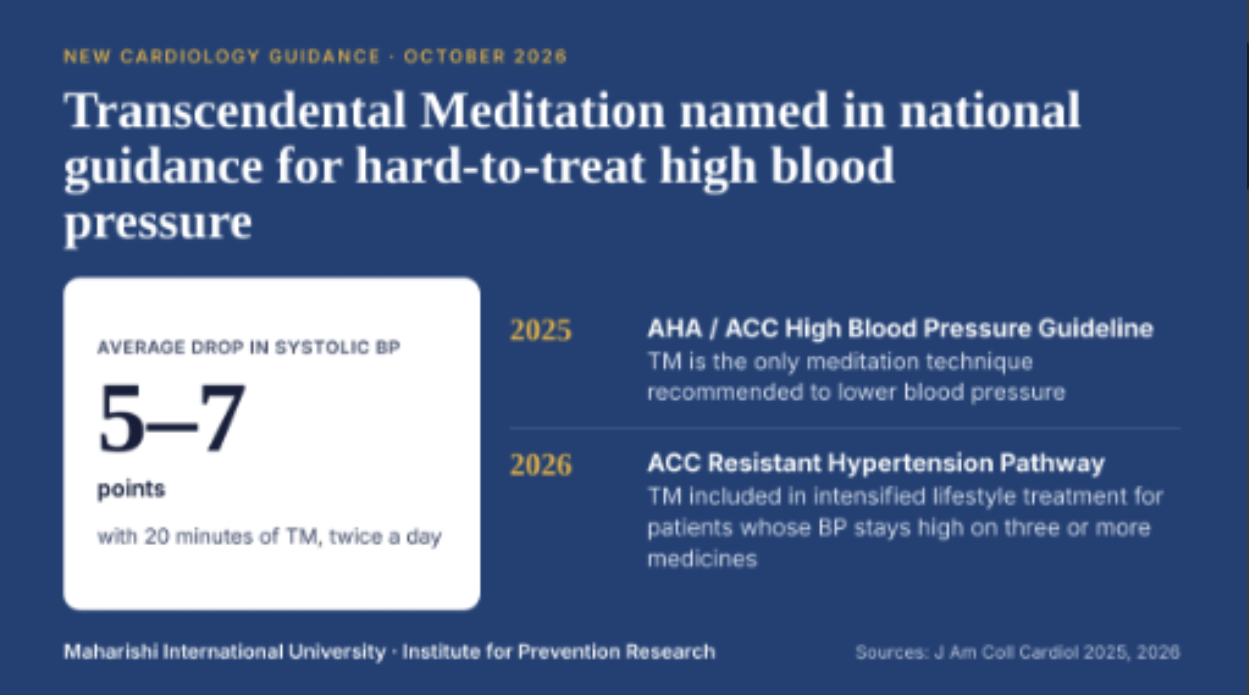
The ACC pathway cites research showing that TM practice can lower systolic blood pressure by about 5 to 7 points on average, a benefit comparable to several established lifestyle interventions. Transcendental Meditation was the only meditation practice included in the guideline’s table of recommended lifestyle measures.
Those few points can matter. A major analysis involving nearly 350,000 patients found that every 5-point reduction in systolic blood pressure is associated with about a 10% reduction in the risk of major cardiovascular events.
Building on a earlier work
The new recommendation builds on a milestone reached in 2025, when the American Heart Association, American College of Cardiology, and eleven partner organizations included TM in the national high blood pressure guideline. That document described TM as the only meditation technique supported by consistent moderate- to high-quality evidence for lowering blood pressure.

Over the past three decades, Robert Schneider, Dr. Sanford Nidich, Dr. John Salerno, Dr. Carolyn Gaylord-King, Maxwell Rainforth, and the late Charles Alexander have helped lead studies examining the effects of TM on blood pressure and cardiovascular health. Their work has been supported by approximately $25 million in primarily NIH-funded research grants.
The evidence includes randomized clinical trials showing reductions in blood pressure, studies reporting fewer heart attacks, strokes, and deaths among long-term TM practitioners, and investigations suggesting that the practice may reduce stress-related activation of the nervous system while improving blood vessel function.
A shift in the mainstream view
“The new resistant hypertension pathway recognizes the importance of addressing stress alongside medication and other lifestyle measures,” said Keith Norris, MD, PhD, of UCLA. “Including Transcendental Meditation gives clinicians an evidence-based, nonpharmacologic option to consider for patients whose blood pressure remains difficult to control.”
“The recommendation represents a significant shift in mainstream medicine’s view of mind-body approaches, said Robert Schneider, a cardiologist, Distinguished Professor of Integrative Medicine and Health, and Director of the Institute for Prevention Research at MIU. “Resistant hypertension is where patients and doctors feel they have run out of options. Seeing Transcendental Meditation in the American College of Cardiology’s pathway for these patients tells clinicians that a safe and effective mind-body practice belongs alongside medication in their repertoire.”
“The recommendation represents a significant shift in mainstream medicine’s view of mind-body approaches.”
— Robert Schneider
The new pathway doesn’t suggest replacing medication. Instead, it recognizes that for patients with the most difficult-to-control blood pressure, addressing chronic stress may be one more avenue for improving outcomes. And with two major cardiology recommendations now citing TM within the span of a year, what was once considered an alternative approach is increasingly finding a place in mainstream cardiovascular care.
For months, Leslie Ciuppa had been hearing about Fairfield’s growing involvement in an international movement to help communities become more innovative, prosperous, and sustainable.
Nahom Abegaze, MIU’s Director of Continuous Improvement, had attended international conferences and returned with enthusiastic accounts of what other communities were accomplishing.
But Ciuppa, MIU’s Vice President of Operational Excellence, didn’t fully appreciate what he was describing.
“I got it before, but I didn’t feel it until I went there and saw how everyone works together.”
— Leslie Ciuppa
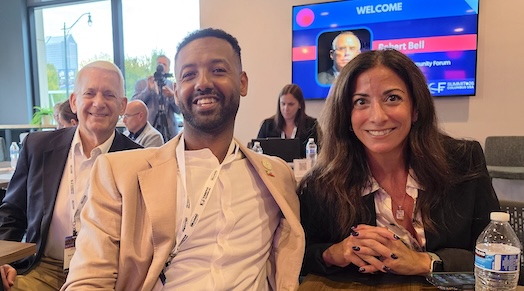
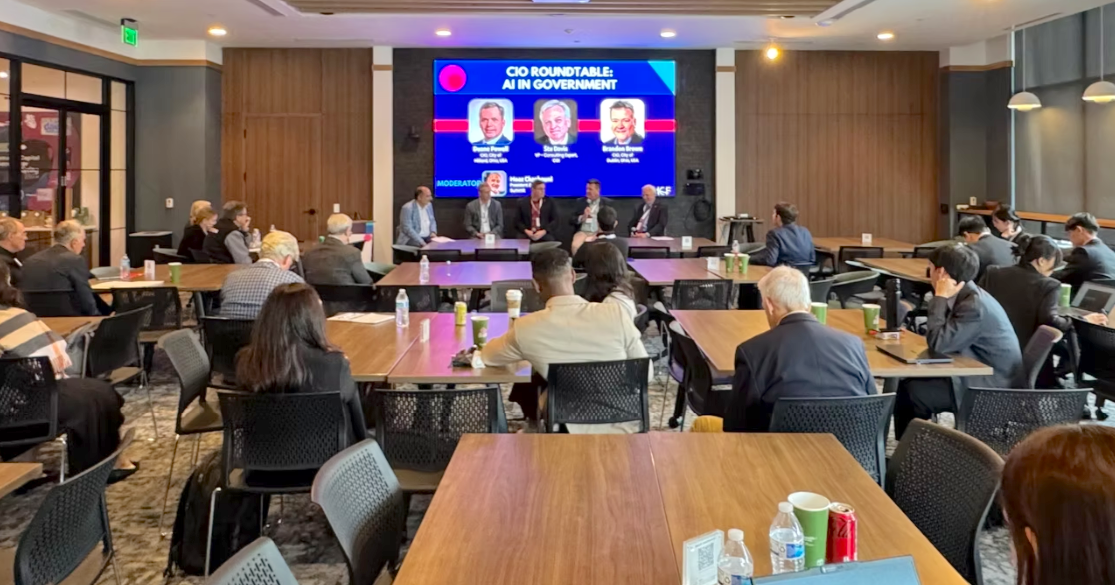
Then, in October, she joined Abegaze and three other Fairfield representatives at the 2026 Intelligent Community Forum (ICF) Global Summit in Columbus, Ohio.
“I got it before, but I didn’t feel it until I went there and saw how everyone works together,” she said.
The summit brought together civic leaders, entrepreneurs, educators, and economic development specialists from communities around the world, including Taiwan, Brazil, Spain, and the Netherlands.
For Ciuppa, the experience was eye-opening.
A small town with an extraordinary distinction
Fairfield had already attracted international attention. In 2025, the Intelligent Community Forum named Fairfield/Jefferson County one of the world’s Top 7 Intelligent Communities — an extraordinary achievement for a community of approximately 10,000 people competing alongside metropolitan regions with populations in the millions.
Fairfield had previously earned Smart21 recognition in 2023 and 2024 and received that distinction again in 2026.
The ICF evaluates communities on six measures: connectivity, workforce development, innovation, digital inclusion, sustainability, and community engagement.
But as Ciuppa discovered, the movement is about much more than technology.
“It’s not about smart cars and all these other things that you’re thinking about,” she explained. Instead, it focuses on bringing universities, businesses, governments, and community organizations together “to create a place where people want to live, work, stay, and invest their time.”
One statistic particularly impressed her.
Fairfield, she reported, has 56.9 microbusinesses (very small enterprises, often run by just one person) per 100 residents, compared with a metropolitan benchmark of 4.8 — nearly twelve times as many.
That remarkable concentration of entrepreneurship is one of Fairfield’s greatest strengths.
“What we have is not intentional yet, but we have this big entrepreneurial ecosystem.”
— Leslie Ciuppa
But Ciuppa sees an opportunity to accomplish much more by bringing together the community’s businesses, educational institutions, talent, and resources.
“What we have is not intentional yet, but we have this big entrepreneurial ecosystem,” she said. “How do we connect businesses, capital, talent, education, government, all together to really work together to be more cohesive?”
What universities can make possible
One of Ciuppa’s most memorable conversations was with an Ohio State University professor who described a 14-week accelerator course in agriculture.
Students work directly with surrounding communities on practical challenges involving water quality, soil, and other agricultural needs.
The communities benefit from the students’ work, while the students gain valuable hands-on experience.
“Now the town is turning to the university to help identify opportunities and address local challenges,” Ciuppa said. “In turn, students gain valuable hands-on experience while contributing to initiatives that move the community forward.”
“Every place that was a top town, universities were really the catalyst for the community transformation.”
— Leslie Ciuppa
She encountered similar examples throughout the summit.
“Every place that was a top town, universities were really the catalyst for the community transformation,” she said. “They’re the connector points, the ones that help bring people together.”
For MIU, the possibilities include student internships, community-based projects, entrepreneurship initiatives, innovation hubs, and partnerships that help graduates build careers locally.
Ciuppa emphasized that attracting talented people is only half the challenge. Communities must also create opportunities that encourage them to stay.
“Economic development is more than attracting businesses,” she said. “It’s about how we’re retaining the talent and creating the opportunity that’s going to strengthen our neighborhoods, support the entrepreneurs, and make this a place people want to come and call home.”
Turning inspiration into action
Joining Ciuppa and Abegaze in Columbus were Fairfield City Councilor Bob Ferguson, Torah Torres, founder and CEO of Adventure CPG, a national distributor serving the natural products industry, and the company’s Chief Strategy Officer, Nevada King.
Abegaze also participated in a summit panel, Workforce of the Future: Skills, Talent & Retention.
For the delegation, the next challenge is translating Columbus’s lessons into coordinated action back home.
“One of my biggest takeaways from attending the conference in Columbus was how important collaboration is in building vibrant, economically thriving communities.”
— Leslie Ciuppa
“One of my biggest takeaways from attending the conference in Columbus was how important collaboration is in building vibrant, economically thriving communities,” Ciuppa said. “Fairfield has already received global recognition for its innovation, entrepreneurship, and community development, and I think there is a real opportunity for MIU to play an even greater role in that progress.”
She sees opportunities for MIU to contribute through student internships, community-based projects, entrepreneurship initiatives, and closer partnerships with local businesses and organizations.
“As one of Fairfield’s key institutions, MIU has so much to contribute through our students, faculty, programs, partnerships, buildings and resources,” she said. “And when Fairfield thrives, MIU benefits as well.”
***
Community members interested in participating can contact Abegaze at nabegaze@miu.ed u and explore the ICF Community Accelerator, an online educational resource made available to Fairfield through donor support.
Banner photo by Jordan Griffith on Unsplash